


What Is 6G? A Complete Introduction to Sixth-Generation Wireless Networks
Wireless communication has evolved continuously from the first generation of mobile networks to today’s 5G systems. Each generation has changed not only how quickly information can be transmitted, but also what a mobile network is capable of supporting.
The next major step in this evolution is 6G, or the sixth generation of wireless communication technology.
6G is expected to become the mobile communication platform for the 2030s and beyond. However, describing 6G simply as a faster version of 5G would miss much of its purpose.
The emerging vision of 6G is much broader. Future networks are expected to combine communication, computing, artificial intelligence, sensing and connectivity more closely than previous generations. Instead of acting only as a network that transports data between devices, 6G is being investigated as an intelligent digital infrastructure capable of connecting people, machines and environments.
Research literature therefore increasingly describes 6G as more than a new radio technology. Qualcomm, for example, describes the emerging platform as a smart wireless communication fabric that builds upon 5G-Advanced while bringing together communication, AI, sensing and new approaches to network efficiency.
What Is 6G?
6G stands for Sixth-Generation Mobile Communication System.
It is the next generation of cellular technology expected to follow 5G and 5G-Advanced.
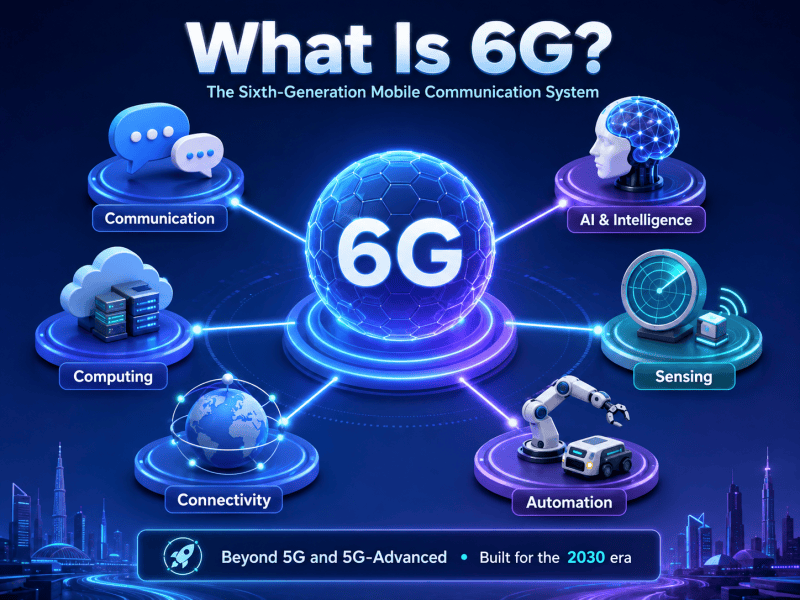
At a basic level: 6G is the future generation of wireless networks being developed for the 2030 era, designed to provide advanced communication while integrating intelligence, computing, sensing and connectivity across a much broader digital ecosystem.
Traditional cellular networks have primarily been designed around communication: transferring voice, messages, video and data between users and applications.

6G is expected to extend this idea.
A future network may not simply answer:
“How can I transmit this data?”
It may increasingly need to understand:
“What information is required?”
“Where should it be processed?”
“What is happening in the surrounding environment?”
“Which network resources should be used?”
“How can communication be optimized automatically?”
This is why 6G research extends beyond radio transmission into areas such as distributed intelligence, computing, sensing, automation and network architecture.
The one6G technology overview, for example, identifies areas including 6G radio access, next-generation MIMO, integrated sensing and communication, non-terrestrial networks, distributed/federated AI, intelligent user-plane technologies, programmable infrastructure and sustainability as important parts of the emerging 6G technology landscape.
Where Does 6G Fit in the Evolution of Mobile Networks?
Mobile networks have historically evolved approximately once every decade.
A simplified view is:
1G → Analog Voice
2G → Digital Voice and SMS
3G → Mobile Internet
4G → Mobile Broadband
5G → Enhanced Broadband + Massive IoT + Low-Latency Communications
5G-Advanced → Further evolution and expansion of 5G capabilities
6G → Intelligent, sensing-aware and highly integrated wireless connectivity for the 2030s
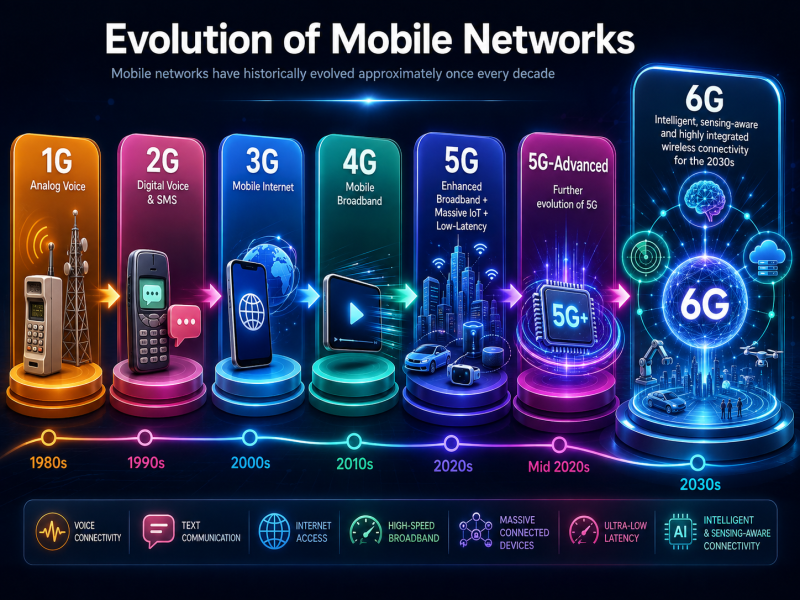
This evolution is important because new generations do not normally appear completely independently of the previous generation.
6G is expected to build upon technologies and deployments developed during the evolution of 5G and particularly 5G-Advanced. The transition is therefore expected to be evolutionary in some areas while introducing more fundamental technological changes in others.
Why Is the Industry Already Working on 6G?
5G is still evolving, so it is reasonable to ask why researchers are already studying another generation. The answer lies in the long development cycle of cellular systems.
Designing a new mobile generation involves years of:
- research,
- technology evaluation,
- spectrum studies,
- industry collaboration,
- standardization,
- prototype development,
- network trials,
- device development,
- interoperability testing,
- and finally commercial deployment.
Previous mobile generations have generally taken many years to progress from initial research to large-scale deployment. Research sources therefore place the main 6G era around 2030 and beyond.
At the same time, future digital systems are expected to place increasingly demanding and diverse requirements on communication networks.
A network may need to support extremely different environments, from dense urban areas and industrial systems to remote regions and potentially non-terrestrial connectivity.
The 6G platform therefore needs to become more adaptable across factors such as throughput, mobility, coverage, latency and reliability.
6G Is More Than Higher Speed
One of the biggest misconceptions about a new wireless generation is that its primary purpose is simply to increase data rate.
Higher capacity and higher data rates will certainly remain important, but the 6G vision is broader.
Consider how cellular networks have evolved.

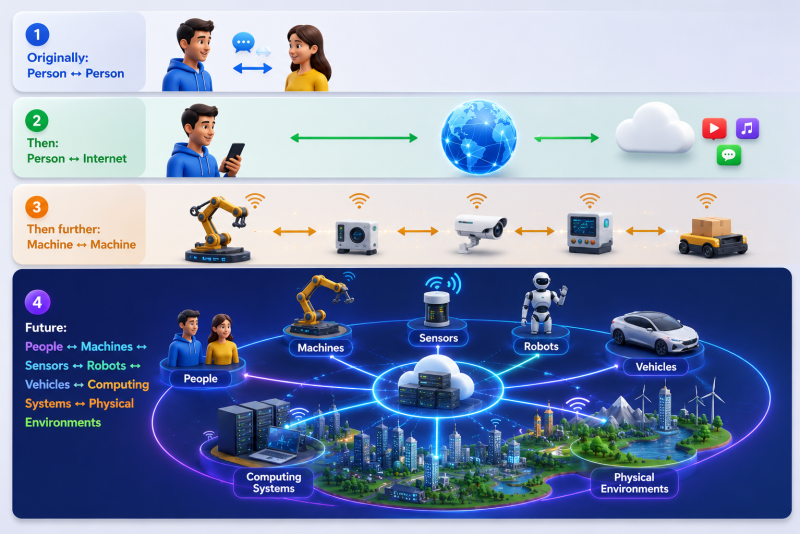
Originally, the network connected:
Person ↔ Person
Then mobile Internet expanded this into:
Person ↔ Internet
IoT expanded it further:
Machine ↔ Machine
Future networks are expected to increasingly connect:
People ↔ Machines ↔ Sensors ↔ Robots ↔ Vehicles ↔ Computing Systems ↔ Physical Environments
This changes what the network needs to do.
A network designed mainly to deliver a video stream has very different requirements from one supporting autonomous machines, intelligent industrial systems, immersive interaction or real-time environmental perception.
Research into 6G therefore increasingly considers the interaction between the physical and digital worlds. The supplied Springer reference describes this continuing convergence of physical and digital systems and identifies 6G as a potential communication backbone for such systems.
The Basic Vision of a 6G Network
A simple conceptual view of today’s mobile network is:
Device → Radio Network → Core Network → Internet / Cloud
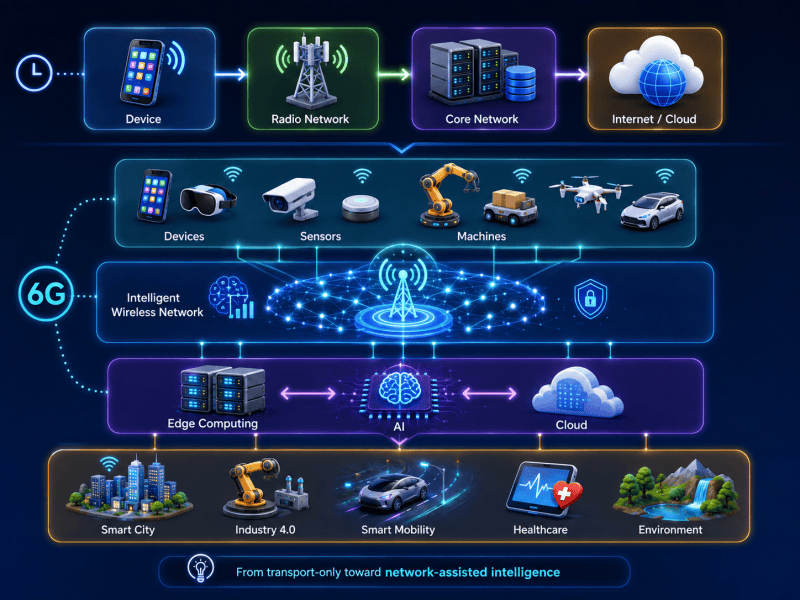
6G is expected to evolve this relationship toward something closer to:
Devices + Sensors + Machines
↓
Intelligent Wireless Network
↓
Edge Computing + AI + Cloud
↓
Applications + Digital Services + Physical Environment
This means future wireless infrastructure may participate more actively in processing information rather than simply transporting it.
For example, intelligence could be distributed between:
- devices,
- the radio access network,
- edge-computing infrastructure,
- core-network functions,
- and cloud platforms.
The exact architecture remains an area of ongoing research and standardization.
That distinction is important: 6G is not yet a fully finalized commercial system.
What Will Make 6G Different?
At this introductory level, several characteristics help distinguish the emerging 6G vision.
Communication will remain the foundation
6G will continue the fundamental role of cellular networks: providing reliable wireless communication.
Future systems are expected to advance performance in areas including capacity, throughput, latency, mobility, coverage and reliability.
However, exact 6G performance targets should not be treated as finalized yet. The source material specifically notes that many detailed KPI targets were still to be formally established as the IMT-2030 framework developed.
This is why statements such as “6G will definitely provide exactly X Tbps” should currently be treated carefully. Research targets are not the same thing as finalized commercial specifications.
Intelligence is expected to become more deeply integrated
AI and machine learning already exist in modern telecommunications networks.
The 6G vision goes further by investigating systems where intelligence can become more deeply integrated into network design, optimization and operation.
Instead of depending entirely on manually engineered optimization rules, future networks may increasingly use data and learning to adapt to changing radio and network conditions.
Some industry visions therefore describe 6G as AI-native rather than merely a network that happens to use AI.
Exactly what an AI-native network means will be covered separately.
Networks may provide sensing as well as communication
Today’s cellular networks are primarily communication systems.
6G research is exploring the possibility of using wireless infrastructure for both:
Communication and Sensing
A radio signal interacting with its surroundings contains information about distance, movement, direction and objects.
Future systems may therefore use wireless signals not only to carry data but also to help understand the physical environment.
This concept is known as Integrated Sensing and Communication, or ISAC, and will have its own detailed series later.
Connectivity is expected to become more ubiquitous
Future connectivity is expected to extend across a wider variety of environments and device types.
This may involve combinations of traditional terrestrial cellular infrastructure with other forms of connectivity.
The overall objective is to move closer to intelligent connectivity that can operate across diverse locations rather than viewing the cellular network only as a collection of ground-based cells serving smartphones.
Efficiency will matter as much as raw performance
Increasing wireless capability cannot simply mean continuously increasing power consumption and infrastructure complexity.
Future network design therefore needs to consider:
energy efficiency, spectrum efficiency, computing efficiency, network cost, and sustainability.
The one6G technology overview treats sustainability as a major 6G research dimension, including power and energy measurement alongside broader research and standardization activity.
6G represents the next major stage in the evolution of mobile communications.
Its purpose is not simply to make smartphones download data faster.
The emerging vision is of a wireless system capable of supporting a much broader digital environment in which communication, computing, intelligence and sensing increasingly work together.
5G-Advanced is expected to provide an important technical foundation for this transition, while research and standardization will determine which candidate technologies ultimately become part of commercial 6G.
Many questions remain open: the exact architecture, spectrum strategy, radio interface, AI integration, sensing mechanisms, performance targets and deployment models will continue evolving.
And that is precisely why 6G should be learned step by step.
References :
- one6G Association, 6G Technology Overview, 4th Edition, September 2024.
- Y. Wu, S. Singh, T. Taleb, A. Roy, H. S. Dhillon, M. R. Kanagarathinam, and A. De, Eds., 6G Mobile Wireless Networks, Springer Nature, 2021.
- Qualcomm Technologies, Inc., Vision, Market Drivers, and Research Directions on the Path to 6G, December 2022.
- W. Chen and P. Jain, Introduction to 3GPP Release 19 and 6G Planning, ATIS, April 2024.
- ITU-R, Framework and Overall Objectives of the Future Development of IMT for 2030 and Beyond, Recommendation ITU-R M.2160-0, 2023.
- 3GPP, 5G-Advanced and 6G Standardization Studies and Specifications.