


A Brief History of Artificial Intelligence
Artificial Intelligence did not begin with modern chatbots. Its development has taken place over several decades.

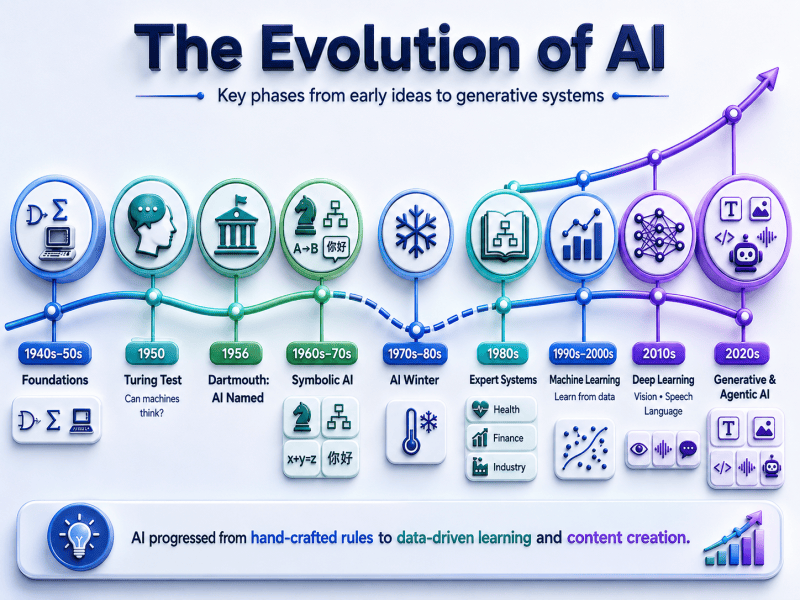
1940s and 1950s: Foundations
Researchers began exploring whether machines could simulate reasoning and computation.
In 1950, mathematician and computer scientist Alan Turing proposed a famous question: Can machines think?
He introduced what later became known as the Turing Test, a method for evaluating whether a machine could demonstrate human-like conversational behaviour.
1956: The Birth of the Term AI
The term “Artificial Intelligence” was formally introduced during the Dartmouth Summer Research Project in 1956.
Researchers believed that aspects of learning and intelligence could be described precisely enough for machines to simulate them.
1960s and 1970s: Early AI Programs
Early AI systems focused on:
- Symbolic reasoning
- Logic
- Game playing
- Mathematical problem solving
- Simple language processing
These systems showed promise, but their capabilities were limited by low computing power and insufficient data.
1970s and 1980s: AI Winters
AI development experienced periods of reduced funding and interest, commonly called AI winters.
Expectations had been extremely high, but available systems could not deliver reliable intelligence at scale.
1980s: Expert Systems
Expert systems became popular. These programs used large collections of human-written rules to imitate the decisions of specialists.
They were used in fields such as:
- Medicine
- Manufacturing
- Finance
- Equipment diagnosis
However, maintaining thousands of rules was expensive and difficult.
1990s and 2000s: Machine Learning Growth
Researchers increasingly focused on systems that could learn from data instead of depending entirely on manually written rules.
Improved computing power, statistical methods, and digital data accelerated machine learning adoption.
2010s: Deep Learning Revolution
Deep learning achieved major improvements in:
- Image recognition
- Speech recognition
- Natural language processing
- Autonomous systems
- Medical imaging
The availability of large datasets, graphics processing units, and improved neural-network architectures made it possible to train much larger models.
2020s: Generative and Agentic AI
Generative AI systems became capable of creating highly realistic text, images, audio, code, and video.
Large Language Models, commonly called LLMs, enabled advanced conversational systems, coding assistants, research tools, and enterprise automation.
The next major development is agentic AI, where AI systems do not merely generate responses but can plan, use tools, interact with software, execute tasks, evaluate results, and work toward goals.