
What Is AI: Artificial Intelligence?
Artificial Intelligence, commonly known as AI, is one of the most influential technologies shaping the modern world. It powers search engines, recommendation systems, voice assistants, autonomous vehicles, fraud-detection platforms, medical diagnostic tools, industrial robots, generative AI applications, and intelligent communication networks.
However, AI is often misunderstood. Many people associate it only with robots, ChatGPT, or machines that behave like humans. In reality, Artificial Intelligence is a broad field that includes many techniques, systems, and technologies designed to make machines perform tasks that normally require human intelligence.
What Is Artificial Intelligence?
Artificial Intelligence is the ability of a computer system or machine to perform tasks that normally require human intelligence.
These tasks may include:
- Learning from experience
- Recognizing images and objects
- Understanding human language
- Making decisions
- Solving problems
- Predicting future outcomes
- Planning actions
- Generating text, images, audio, or video
- Interacting with people
- Adapting to changing situations
In simple words, AI enables machines to observe, understand, learn, reason, decide, and act.
For example:
- A spam filter identifies unwanted emails.
- A navigation application recommends the fastest route.
- A banking system detects suspicious transactions.
- A chatbot answers customer question.
- A recommendation engine suggests movies or products.
- A telecom network predicts failures before they occur.
- A generative AI model creates text, images, code, or music.
These systems may appear intelligent, but they do not necessarily think exactly like humans. Most AI systems are designed to perform specific tasks using data, algorithms, mathematical models, and computing power.
A Simple Example of Artificial Intelligence
Consider an email spam-detection system.
A traditional rule-based system may use fixed rules such as:
- If the email contains “You won a prize,” mark it as spam.
- If the sender is unknown and the email contains multiple links, mark it as suspicious.
- If the subject contains certain words, move the email to the spam folder.
This approach may work initially, but spammers can change their wording and bypass the rules.
An AI-based spam-detection system works differently. It studies thousands or millions of previous emails and learns patterns associated with spam, such as:
- Unusual language
- Suspicious links
- Sender reputation
- Message structure
- Repeated phrases
- User-reported spam
- Abnormal sending behaviour
The system then uses these learned patterns to estimate whether a new email is spam.
The important difference is that the AI system does not rely only on manually written rules. It can learn patterns from data and improve its predictions over time.
Why Is It Called Artificial Intelligence?
The term contains two important words:
Artificial: “Artificial” means created by humans rather than occurring naturally.
Intelligence: “Intelligence” refers to the ability to learn, understand, reason, solve problems, make decisions, and adapt.
Therefore, Artificial Intelligence refers to human-created systems that demonstrate capabilities associated with intelligence.
The term does not imply that every AI system has consciousness, emotions, self-awareness, or human-level understanding. Most current AI systems are highly specialized mathematical systems trained to perform specific tasks.
How Is AI Different from Traditional Programming?
In traditional programming, a developer writes explicit instructions that tell the computer exactly what to do.
The basic flow is: Rules + Input Data → Output
For example, a programmer may write a rule stating:
If temperature is greater than 40°C, generate a high-temperature warning.
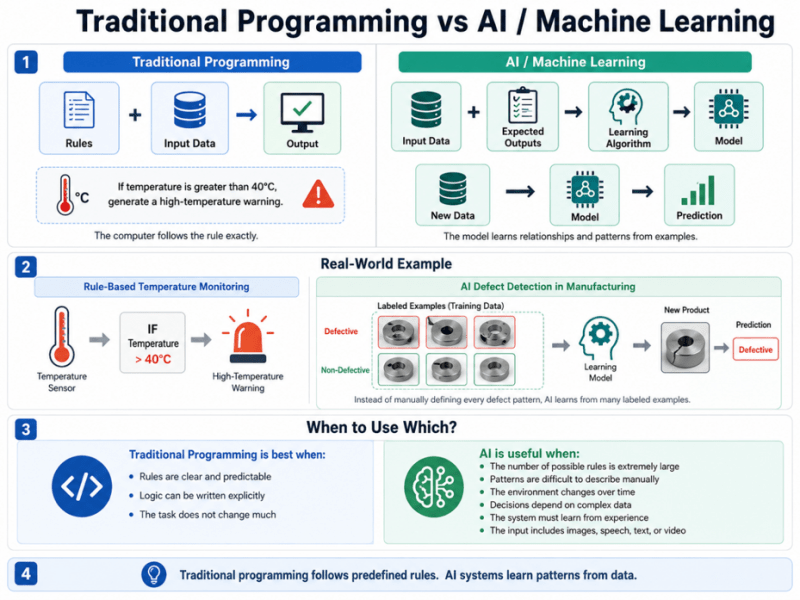
The computer follows the rule exactly.
In many AI and machine learning systems, the flow is different:
Input Data + Expected Outputs → Learning Algorithm → Model
The model learns relationships and patterns from examples. It can then make predictions for new data.

For example, instead of manually defining every possible pattern of a defective product, an AI model can learn from thousands of images labelled “defective” and “non-defective.”
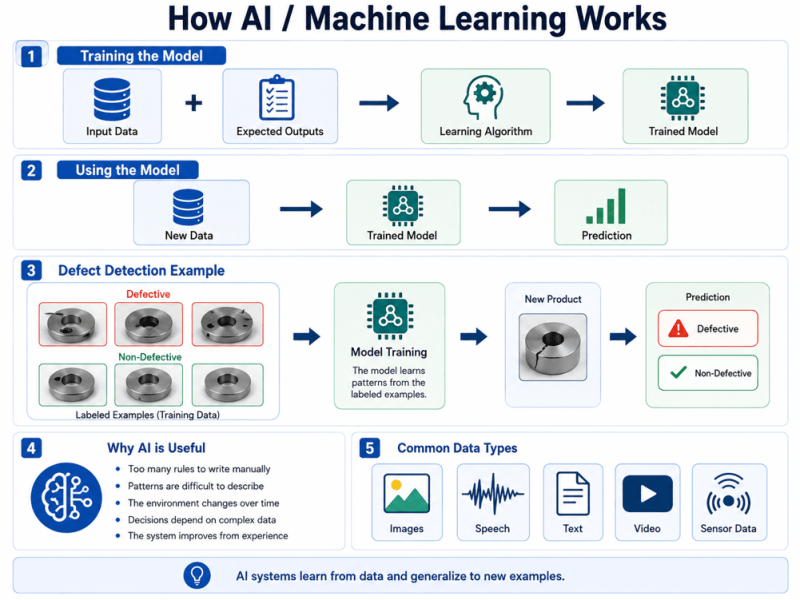
Traditional programming is best suited to problems where the rules are clear and predictable. AI is useful when:
- The number of possible rules is extremely large.
- The patterns are difficult to describe manually.
- The environment changes over time.
- Decisions depend on complex data.
- The system must learn from experience.
- The input includes images, speech, text, or video.
The Core Capabilities of Artificial Intelligence
AI systems can be designed with one or more intelligent capabilities.
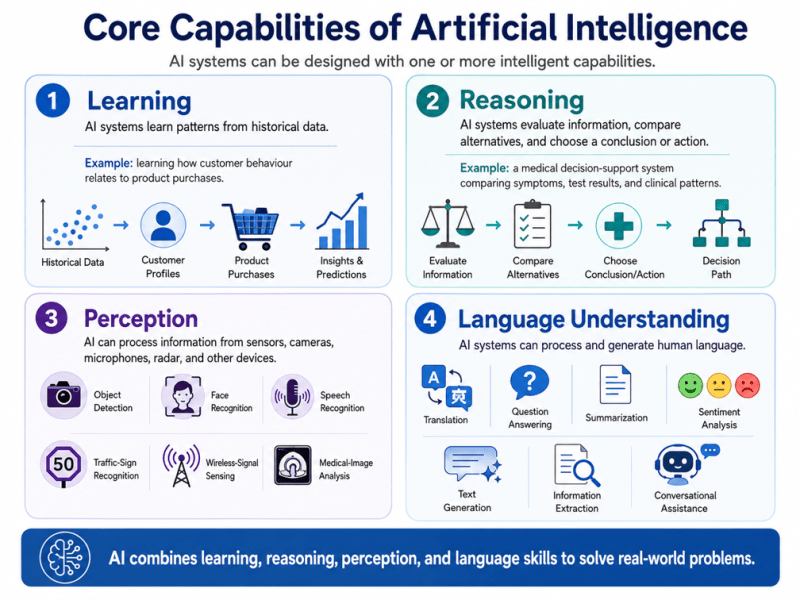
Learning
AI systems can learn patterns from historical data.For example, a model can learn how customer behaviour relates to product purchases.
Reasoning
Some AI systems evaluate information, compare alternatives, and select an appropriate conclusion or action. For example, a medical decision-support system may compare symptoms, test results, and known clinical patterns.
Perception
AI can process information obtained from sensors, cameras, microphones, radar, or other devices.
Examples include:
- Object detection
- Face recognition
- Speech recognition
- Traffic-sign recognition
- Wireless-signal sensing
- Medical-image analysis
Language Understanding
AI systems can process and generate human language.
They can perform tasks such as:
- Translation
- Question answering
- Summarization
- Sentiment analysis
- Text generation
- Information extraction
- Conversational assistance
Prediction
AI models can estimate future or unknown outcomes.
Examples include:
- Predicting equipment failure
- Forecasting product demand
- Estimating credit risk
- Predicting network congestion
- Forecasting customer churn
- Identifying disease risk
Planning
AI systems can determine a sequence of actions required to achieve a goal.
Examples include:
- Robot navigation
- Delivery-route optimization
- Manufacturing planning
- Network-resource allocation
- Automated scheduling
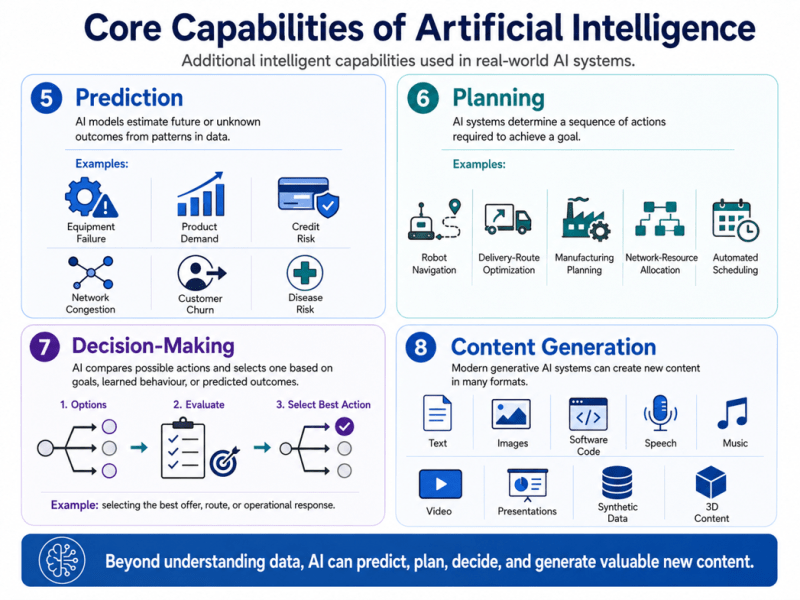
Decision-Making
AI can compare possible actions and select one based on predefined goals, learned behaviour, or predicted outcomes.
Content Generation
Modern generative AI systems can create:
- Text
- Images
- Software code
- Speech
- Music
- Video
- Presentations
- Synthetic data
- 3D content
A Brief History of Artificial Intelligence
Artificial Intelligence did not begin with modern chatbots. Its development has taken place over several decades.
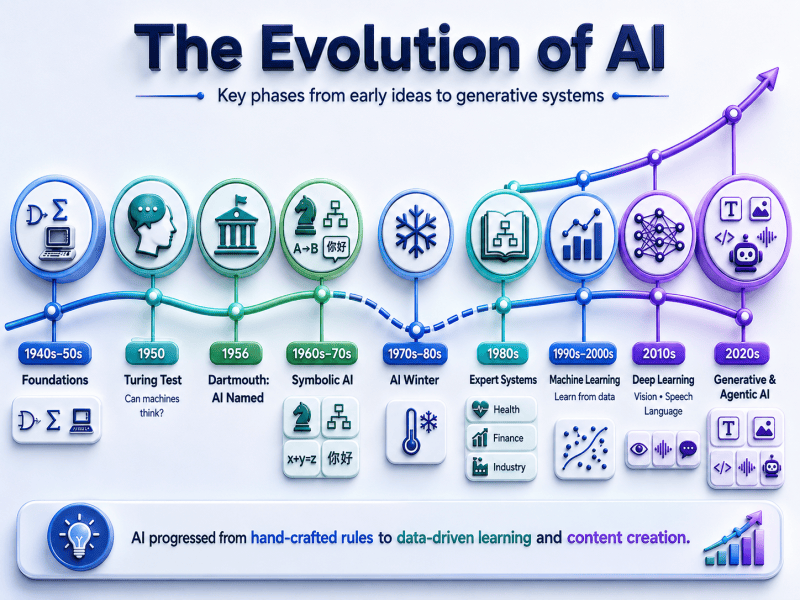
1940s and 1950s: Foundations
Researchers began exploring whether machines could simulate reasoning and computation.
In 1950, mathematician and computer scientist Alan Turing proposed a famous question: Can machines think?
He introduced what later became known as the Turing Test, a method for evaluating whether a machine could demonstrate human-like conversational behaviour.
1956: The Birth of the Term AI
The term “Artificial Intelligence” was formally introduced during the Dartmouth Summer Research Project in 1956.
Researchers believed that aspects of learning and intelligence could be described precisely enough for machines to simulate them.
1960s and 1970s: Early AI Programs
Early AI systems focused on:
- Symbolic reasoning
- Logic
- Game playing
- Mathematical problem solving
- Simple language processing
These systems showed promise, but their capabilities were limited by low computing power and insufficient data.
1970s and 1980s: AI Winters
AI development experienced periods of reduced funding and interest, commonly called AI winters.
Expectations had been extremely high, but available systems could not deliver reliable intelligence at scale.
1980s: Expert Systems
Expert systems became popular. These programs used large collections of human-written rules to imitate the decisions of specialists.
They were used in fields such as:
- Medicine
- Manufacturing
- Finance
- Equipment diagnosis
However, maintaining thousands of rules was expensive and difficult.
1990s and 2000s: Machine Learning Growth
Researchers increasingly focused on systems that could learn from data instead of depending entirely on manually written rules.
Improved computing power, statistical methods, and digital data accelerated machine learning adoption.
2010s: Deep Learning Revolution
Deep learning achieved major improvements in:
- Image recognition
- Speech recognition
- Natural language processing
- Autonomous systems
- Medical imaging
The availability of large datasets, graphics processing units, and improved neural-network architectures made it possible to train much larger models.
2020s: Generative and Agentic AI
Generative AI systems became capable of creating highly realistic text, images, audio, code, and video.
Large Language Models, commonly called LLMs, enabled advanced conversational systems, coding assistants, research tools, and enterprise automation.
The next major development is agentic AI, where AI systems do not merely generate responses but can plan, use tools, interact with software, execute tasks, evaluate results, and work toward goals.
Major Types of Artificial Intelligence
AI can be classified according to its capabilities and functionality.
Artificial Narrow Intelligence
Artificial Narrow Intelligence, or ANI, refers to AI designed for a specific task or limited set of tasks.
Examples include:
- Face-recognition systems
- Recommendation engines
- Voice assistants
- Fraud-detection models
- Chess-playing programs
- Language-translation systems
- Network-fault prediction
- Medical-image classification
Almost all widely deployed AI systems today belong to this category.
A narrow AI system may perform one task extremely well but may not be able to transfer its intelligence to unrelated tasks.
For example, an AI system trained to detect lung disease in X-rays cannot automatically drive a car or manage a telecom network.
Artificial General Intelligence
Artificial General Intelligence, or AGI, refers to a hypothetical system capable of understanding, learning, and performing a wide range of intellectual tasks at a level comparable to humans.
An AGI system would theoretically be able to:
- Learn new subjects
- Transfer knowledge across domains
- Reason about unfamiliar situations
- Plan complex activities
- Understand context deeply
- Adapt without being retrained for every individual task
AGI remains a research goal rather than an established, universally achieved technology.
Artificial Superintelligence
Artificial Superintelligence, or ASI, refers to a hypothetical form of intelligence that exceeds human abilities across most or all intellectual areas.
It may outperform humans in:
- Scientific discovery
- Strategic planning
- Creativity
- Engineering
- Decision-making
- Problem solving
- Social understanding
ASI is currently a theoretical concept and is frequently discussed in debates about AI governance, alignment, control, and long-term safety.
Artificial Intelligence, Machine Learning, and Deep Learning
These terms are related but not identical.

Artificial Intelligence AI is the broad field of creating machines that perform tasks associated with intelligence.
Machine Learning Machine Learning is a subset of AI in which systems learn patterns from data.Instead of programming every rule, developers provide data and a learning algorithm.
Deep Learning Deep Learning is a subset of Machine Learning based on multi-layered artificial neural networks.It is especially useful for complex data such as:
- Images
- Audio
- Natural language
- Video
- Sensor signals
- Large-scale behavioural data
The relationship can be represented as:
Artificial Intelligence → Machine Learning → Deep Learning
Not every AI system uses machine learning, and not every machine learning model uses deep learning. For example, a rule-based expert system is an AI system but may not use machine learning.
What Is Generative AI?
Generative AI is a branch of AI designed to create new content. Traditional AI systems often classify, predict, or detect something. Generative AI produces new outputs based on patterns learned during training.

It can generate:
- Articles
- Emails
- Images
- Presentations
- Computer code
- Music
- Videos
- Product designs
- Synthetic datasets
Examples of generative AI tasks include:
- Writing a product description
- Generating an image from a text prompt
- Creating software code
- Summarizing a report
- Producing a marketing campaign
- Designing a network-test script
- Creating simulated training data
Generative AI does not simply copy its training data. It learns statistical patterns and uses them to generate new combinations. However, its output may still be incorrect, biased, incomplete, or too similar to existing material, so human review remains important.
What Are Large Language Models?
Large Language Models are AI models trained on very large collections of text and related data. They learn patterns involving:
- Grammar
- Vocabulary
- Sentence structure
- Context
- Concepts
- Relationships between words
- Common reasoning patterns
- Programming languages
- Document formats
LLM processes text as smaller units called tokens. When generating a response, it predicts a suitable sequence of tokens based on:
- The user’s input
- Previous conversation context
- Patterns learned during training
- System instructions
- Additional retrieved information
- Available tools
LLMs can perform multiple language-related tasks without requiring a separate model for every task.

However, an LLM does not automatically guarantee truth. It may generate information that sounds convincing but is inaccurate. This behaviour is often called an AI hallucination.
For reliable applications, LLMs may be combined with:
- Verified databases
- Search systems
- Retrieval-Augmented Generation
- Business rules
- Human approval
- External tools
- Fact-checking mechanisms
What Is Agentic AI?
Agentic AI refers to AI systems that can take goal-directed actions rather than only provide a single response. A basic chatbot follows this pattern:
User Question → AI Response
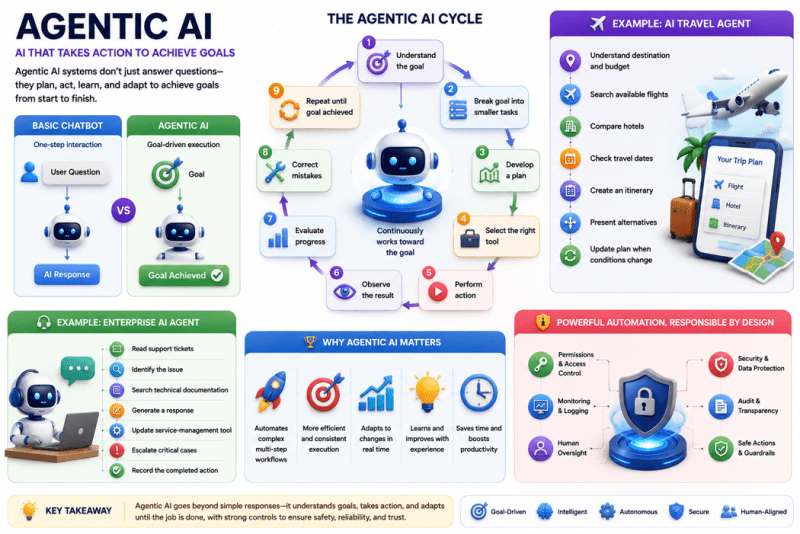
An AI agent may follow a more advanced cycle:
- Understand the goal
- Break the goal into smaller tasks
- Develop a plan
- Select an appropriate tool
- Perform an action
- Observe the result
- Evaluate progress
- Correct mistakes
- Continue until the goal is achieved
For example, an AI travel agent may:
- Understand the destination and budget
- Search available flights
- Compare hotels
- Check travel dates
- Create an itinerary
- Present alternatives
- Update the plan when conditions change
An enterprise AI agent may:
- Read support tickets
- Identify the issue
- Search technical documentation
- Generate a response
- Update a service-management tool
- Escalate critical cases
- Record the completed action
Agentic AI introduces powerful automation possibilities, but it also requires strong controls, permissions, monitoring, security, and human oversight.
Major Branches of Artificial Intelligence
Artificial Intelligence contains many specialized areas.
Machine Learning Machine learning enables systems to learn from data and make predictions or decisions.
Deep Learning Deep learning uses multi-layer neural networks for complex pattern recognition.
Natural Language Processing Natural Language Processing, or NLP, enables machines to understand, process, and generate human language.
Applications include:
- Translation
- Chatbots
- Text summarization
- Sentiment analysis
- Voice assistants
- Document analysis
Computer Vision Computer vision enables machines to understand images and videos.
Applications include:
- Object detection
- Facial recognition
- Medical-image analysis
- Manufacturing inspection
- Autonomous driving
- Surveillance
- Satellite-image analysis
Speech Processing
Speech AI supports:
- Speech-to-text
- Text-to-speech
- Speaker recognition
- Voice authentication
- Voice assistants
- Call-centre analytics
Robotics Robotics combines AI with sensors, mechanical systems, control algorithms, and actuators.
AI-powered robots can:
- Navigate environments
- Pick and place objects
- Inspect equipment
- Assist in surgery
- Work in warehouses
- Support disaster response
Expert Systems Expert systems use knowledge bases and rules to imitate specialist decision-making.
Reinforcement Learning Reinforcement Learning enables an AI agent to learn through interaction.
The agent:
- Observes the environment
- Takes an action
- Receives a reward or penalty
- Updates its behaviour
It is used in robotics, gaming, resource management, network optimization, and control systems.
Knowledge Representation and Reasoning This field focuses on representing facts, relationships, rules, and concepts in a form that machines can process.
AI Planning and Optimization These systems identify actions or resource allocations that achieve a goal efficiently.Applications include logistics, manufacturing, scheduling, wireless networks, and supply-chain management.
How Does an AI System Work?
The exact process depends on the type of AI system, but a typical machine learning workflow includes the following stages.
Define the Problem The first step is to clearly identify the task.
Examples:
- Predict whether a customer will leave.
- Detect a damaged product.
- Estimate network congestion.
- Identify fraudulent transactions.
- Generate answers from company documents.
A poorly defined problem usually leads to a poorly performing AI solution.

Collect Data AI systems require relevant data.
The data may include:
- Tables
- Text
- Images
- Audio
- Video
- Sensor readings
- Network logs
- Customer transactions
- Device telemetry
The data must represent the real environment in which the AI system will operate.
Prepare the Data Raw data often contains:
- Missing values
- Duplicate records
- Incorrect labels
- Inconsistent formats
- Noise
- Outliers
- Irrelevant information
Data preparation may involve cleaning, transforming, combining, labelling, and normalizing the data.
Select Features or Representations
Features are the input variables used by a model. For a house-price prediction system, features may include:
- Location
- Area
- Number of rooms
- Building age
- Distance from public transport
In deep learning, the system may automatically learn useful representations from raw input.
Select an Algorithm The algorithm depends on the problem.
Examples include:
- Linear regression
- Logistic regression
- Decision trees
- Random forests
- Support vector machines
- Neural networks
- Transformers
- Clustering algorithms
- Reinforcement learning algorithms
Train the Model
During training, the model processes examples and adjusts its internal parameters to reduce prediction errors.
A mathematical function called a loss function measures the difference between the model’s prediction and the expected output.
An optimization algorithm updates the model to reduce this loss.
Validate and Test the Model The model must be evaluated on data that was not used for training.
Common evaluation metrics include:
- Accuracy
- Precision
- Recall
- F1-score
- Mean absolute error
- Root mean square error
- Area under the curve
- Response quality
- Latency
- Reliability
The correct metric depends on the business problem.
Deploy the Model
After successful testing, the model may be deployed in:
- A website
- A mobile application
- A cloud platform
- An embedded device
- A telecom network
- A factory
- A hospital system
- A customer-support platform
Monitor the Model
AI performance may decline after deployment because real-world data changes.
Monitoring may include:
- Accuracy
- Data drift
- Model drift
- Response time
- Bias
- Failure rate
- Security issues
- Resource consumption
Retrain and Improve
The system may need new data, updated features, modified algorithms, or additional safeguards. AI development is therefore not a one-time activity. It is a continuous lifecycle.
Types of Machine Learning Used in AI
Supervised Learning In supervised learning, a model is trained using labelled examples.
Each training example contains:
- Input features
- Correct output or label
Examples:
- Email → Spam or Not Spam
- Medical image → Disease or No Disease
- Customer details → Will Leave or Will Stay
- House details → Predicted Price
Supervised learning is commonly used for classification and regression.
Unsupervised Learning
In unsupervised learning, the data does not contain predefined output labels. The model tries to identify hidden patterns or groups.
Applications include:
- Customer segmentation
- Anomaly detection
- Pattern discovery
- Document grouping
- Network-behaviour analysis
Semi-Supervised Learning
Semi-supervised learning uses a small amount of labelled data and a larger amount of unlabelled data. It is useful when manual labelling is expensive.
Self-Supervised Learning
Self-supervised learning creates training signals from the data itself. It is widely used in modern language and vision models. For example, a language model may learn by predicting missing or next tokens.
Reinforcement Learning
In reinforcement learning, an agent learns by interacting with an environment and receiving rewards or penalties.
Neural Networks and Deep Learning
Artificial neural networks are computational systems inspired loosely by biological neural networks.
A neural network usually contains:
- An input layer
- One or more hidden layers
- An output layer
Each connection has a numerical weight. During training, the network adjusts these weights to improve its predictions. A deep neural network contains many processing layers.
Popular deep-learning architectures include:
Convolutional Neural Networks
Commonly used for image and spatial-data processing.
Recurrent Neural Networks
Designed for sequential data, although many language tasks now use transformer architectures.
Long Short-Term Memory Networks
A specialized recurrent architecture designed to retain information over longer sequences.
Transformers
Transformer architectures are widely used in modern language, vision, speech, and multimodal AI systems. They use a mechanism called attention to identify which parts of the input are most relevant. Transformers form the foundation of many Large Language Models and generative AI systems.
Real-World Applications of Artificial Intelligence
AI is used across almost every major industry.
Healthcare
AI supports:
- Medical-image analysis
- Disease-risk prediction
- Drug discovery
- Patient monitoring
- Clinical documentation
- Treatment planning
- Hospital-resource optimization
AI should generally support, not blindly replace, qualified medical professionals.
Banking and Finance
AI is used for:
- Fraud detection
- Credit-risk analysis
- Algorithmic trading
- Customer-service automation
- Anti-money-laundering systems
- Document processing
- Financial forecasting
Telecommunications
AI supports:
- Network optimization
- Traffic prediction
- Fault detection
- Predictive maintenance
- Energy optimization
- Customer-experience management
- Root-cause analysis
- Self-healing networks
- Radio-resource management
- Mobility optimization
In 5G and future 6G systems, AI is expected to play an increasingly important role in network automation, sensing, digital twins, and intelligent control.
Manufacturing
Applications include:
- Predictive maintenance
- Quality inspection
- Industrial robotics
- Process optimization
- Demand forecasting
- Supply-chain management
Transportation
AI supports:
- Route optimization
- Driver-assistance systems
- Autonomous vehicles
- Fleet management
- Traffic forecasting
- Accident-risk detection
Education
AI can provide:
- Personalized learning
- Automated feedback
- Question generation
- Learning analytics
- Language assistance
- Intelligent tutoring
Retail and E-Commerce
AI is used for:
- Product recommendations
- Demand forecasting
- Dynamic pricing
- Inventory management
- Customer segmentation
- Visual search
- Chatbots
Cybersecurity
AI can detect:
- Malware
- Unusual user behaviour
- Network attacks
- Phishing
- Account compromise
- Suspicious transactions
Attackers can also use AI, making AI-enabled cybersecurity a continuously evolving field.
Agriculture
AI supports:
- Crop monitoring
- Disease detection
- Smart irrigation
- Yield prediction
- Drone-based inspection
- Soil analysis
Media and Entertainment
AI enables:
- Content recommendations
- Video editing
- Game intelligence
- Music generation
- Visual-effects automation
- Content moderation
Government and Public Services
AI may support:
- Traffic management
- Public-resource planning
- Disaster response
- Document processing
- Citizen-service automation
- Infrastructure monitoring
Such applications require transparency, accountability, privacy protection, and human oversight.
Benefits of Artificial Intelligence
- Automation AI can automate repetitive and time-consuming activities.
- Speed AI systems can process large volumes of information faster than humans.
- Consistency A properly designed system can apply the same evaluation criteria across many cases.
- Pattern Detection AI can identify complex patterns that may be difficult for humans to detect manually.
- Improved Decision Support AI can help professionals make more informed decisions.
- Personalization AI can adapt recommendations, learning content, and services to individual users.
- Continuous Operation AI systems can operate continuously, subject to infrastructure availability and maintenance.
- Safety AI can perform tasks in hazardous environments such as mines, disaster zones, industrial plants, or high-radiation areas.
- Innovation AI enables new products, services, business models, and scientific discoveries.
Limitations and Challenges of Artificial Intelligence
AI is powerful, but it is not automatically intelligent, fair, or reliable.
- Dependence on Data A model’s quality depends heavily on the quality and relevance of its data.Poor data can produce poor results.
- Bias If training data contains historical or social biases, the model may learn and reproduce them.
- Lack of True Understanding Many AI systems detect statistical patterns without understanding the world in the same way humans do.
- Hallucinations Generative AI systems may produce incorrect or fabricated information.
- Explainability Complex models may make decisions that are difficult to interpret.This is especially important in healthcare, finance, law, hiring, and critical infrastructure.
- Privacy AI systems may process sensitive personal, business, or operational data.Strong data-governance mechanisms are essential.
- Security
- AI systems can be attacked through:
- Malicious prompts
- Poisoned training data
- Adversarial inputs
- Model theft
- Unauthorized tool use
- Sensitive-data extraction
- High Computing Requirements Training and operating large AI models may require significant computing infrastructure, energy, and financial investment.
- Model Drift Model accuracy may decrease as real-world behaviour changes.
- Over-Reliance Users may trust AI output without verifying it.AI should be treated as a decision-support tool, particularly in high-impact applications.
Artificial Intelligence is the field of building machines and software systems capable of performing tasks associated with human intelligence.
AI systems may learn from data, recognize patterns, understand language, generate content, make predictions, recommend actions, and interact with the physical or digital world.
The AI ecosystem includes:
- Rule-based systems
- Machine Learning
- Deep Learning
- Natural Language Processing
- Computer Vision
- Robotics
- Generative AI
- Large Language Models
- Retrieval-Augmented Generation
- Agentic AI
AI offers enormous opportunities in healthcare, education, telecommunications, finance, manufacturing, transportation, research, cybersecurity, and many other industries.
At the same time, AI systems are not automatically correct, unbiased, secure, or responsible. Their success depends on good data, appropriate algorithms, careful evaluation, human oversight, responsible governance, and continuous monitoring.
The most important idea to remember is: Artificial Intelligence is not simply about making machines imitate humans. It is about building systems that can use data, learning, reasoning, and computation to solve real-world problems intelligently.
References and Further Reading
- Turing, A. M. (1950). Computing machinery and intelligence. Mind, 59(236), 433–460. doi:10.1093/mind/LIX.236.433.
- McCarthy, J., Minsky, M. L., Rochester, N., & Shannon, C. E. (1955). A proposal for the Dartmouth Summer Research Project on Artificial Intelligence. AI Magazine, 27(4), 12–14. doi:10.1609/aimag.v27i4.1904.
- Russell, S. J., & Norvig, P. (2021). Artificial Intelligence: A Modern Approach (4th ed.). Pearson.
- Organisation for Economic Co-operation and Development. (2024). Explanatory memorandum on the updated OECD definition of an AI system. OECD Artificial Intelligence Papers. doi:10.1787/623da898-en.
- Organisation for Economic Co-operation and Development. (2024). OECD principles on artificial intelligence. OECD.
- LeCun, Y., Bengio, Y., & Hinton, G. (2015). Deep learning. Nature, 521, 436–444. doi:10.1038/nature14539.
- Sutton, R. S., & Barto, A. G. (2018). Reinforcement Learning: An Introduction (2nd ed.). MIT Press.
- Vaswani, A., Shazeer, N., Parmar, N., Uszkoreit, J., Jones, L., Gomez, A. N., Kaiser, Ł., & Polosukhin, I. (2017). Attention is all you need. Advances in Neural Information Processing Systems, 30, 5998–6008.
- Lewis, P., Perez, E., Piktus, A., Petroni, F., Karpukhin, V., Goyal, N., Küttler, H., Lewis, M., Yih, W., Rocktäschel, T., Riedel, S., & Kiela, D. (2020). Retrieval-augmented generation for knowledge-intensive NLP tasks. Advances in Neural Information Processing Systems, 33, 9459–9474.
- Yao, S., Zhao, J., Yu, D., Du, N., Shafran, I., Narasimhan, K., & Cao, Y. (2023). ReAct: Synergizing reasoning and acting in language models. International Conference on Learning Representations.
- Tabassi, E. (2023). Artificial Intelligence Risk Management Framework: AI RMF 1.0. National Institute of Standards and Technology. doi:10.6028/NIST.AI.100-1.
- Autio, C., Schwartz, R., Dunietz, J., Jain, S., Stanley, M., Tabassi, E., Hall, P., & Roberts, K. (2024). Artificial Intelligence Risk Management Framework: Generative Artificial Intelligence Profile. National Institute of Standards and Technology. doi:10.6028/NIST.AI.600-1.
- United Nations Educational, Scientific and Cultural Organization. (2021). Recommendation on the Ethics of Artificial Intelligence. UNESCO.
- Stanford Institute for Human-Centered Artificial Intelligence. (2026). The 2026 AI Index Report. Stanford University.
- Russell, S., Dewey, D., & Tegmark, M. (2015). Research priorities for robust and beneficial artificial intelligence. AI Magazine, 36(4), 105–114.
- Brundage, M., Avin, S., Clark, J., Toner, H., Eckersley, P., Garfinkel, B., Dafoe, A., Scharre, P., Zeitzoff, T., Filar, B., Anderson, H., Roff, H., Allen, G. C., Steinhardt, J., Flynn, C., Ó hÉigeartaigh, S., Beard, S., Belfield, H., Farquhar, S., Lyle, C., Crootof, R., Evans, O., Page, M., Bryson, J., Yampolskiy, R., & Amodei, D. (2018). The malicious use of artificial intelligence: Forecasting, prevention, and mitigation.